
Linkages to Greece
Saskatoon’s History Through the Lives and Experiences of its Greek Community
This website celebrates the lives and experiences of the Greeks who came to Saskatoon, remembers their experiences in this city, and recognizes their contributions. In addition to their desire to make a new life for themselves and their children, they also maintained ties with the communities and families remaining in Greece.
In this chapter, we acknowledge the the early Greek immigrants’ familial and cultural ties to Greece. The linkages were often not just emotional and cultural; financial obligations through frequent remittances to parents and siblings and to the communities in which they were born were often prioritized over their own personal well-being. The early Greek immigrants continued to feel a kinship with the people in the communities in which they were born and generally contributed to the reconstruction and modernization of post-war Greece, paricularly during the 1950s.
Linkages to the Kastri District in Arcadia, Greece (1983)
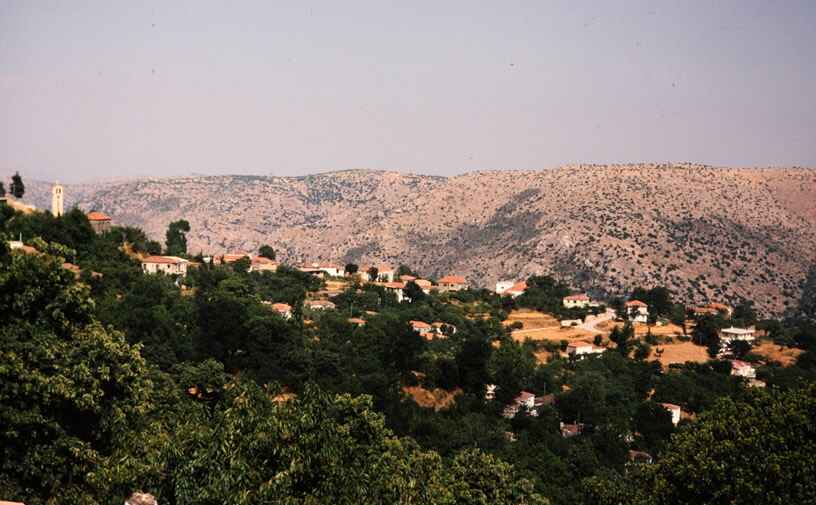
Ayios Nicholaos (Kastri), Arcadia, Greece (1978)
With Saskatoon celebrating its 100th birthday, Greek Canadians of the province, having immigrated from a culture which is some thousands of years old, continue to conserve fondly various ties to the old country. They are also, to be sure, striving through restaurant enterprises and diverse other activity to integrate themselves successfully and vigorously in the fabric of modern Canada, as Canadians. All this contributes toward the prosperity and vitality of Saskatchewan. The duality of their experience and interests has repercussions in Greece as well.
Migration is a two-way street and the cultural interdependence of Saskatchewan’s some 2,000 people of Greek descent has been mutually rewarding and stimulating to themselves and to non-Greeks. In recent years definite “multicultural bridges” appeared, as for example, through growing popularity of the Greek cuisine. This appreciation by Canadians of Greek foods has been associated with a new wave of tourism; Greece… once visited mainly by those non-Greeks who focused somewhat exclusively on the special attractions of its ancient history is now an outstandingly popular target for vacation sojourns by many more people whose interests are more broadly focused in terms of present-day Greece.
For some time now, festivals such as Mosaic of Regina, Folkfest of Saskatoon, and Folklorama of Swift Current provide emergent benefits for both sides in the two-way street of multiculturalism. Canadians continue to profit from the energy and added exciting cultural flavour provided by this Greek element and those of other ethnocultural groups in our social mosaic.
One can quite literally say “flavour” in such matters as souvlaki, baklava, and other Greek ethnic foods in what is now recognized as an increasingly attractive overall variety which tends to enhance the range of Canadian food choices, as with egg rolls, pizza and perogies, etc., from the several other ethnic groups’ contributions.
The Greek language classes which came into existence over 20 years ago, long before there was government support for them, now include non-Greek students. Special adult classes catering almost exclusively to non-Greeks are frequented by young and old Canadians from other ethnic backgrounds who intend to visit (or re-visit) Greece. Many of these students are spouses in mixed marriages.
There are multicultural links through religious ties as in Greek and Russian/Ukrainian or Romanian Orthodoxy. Many business links between Greeks and non-Greeks have been building up through the years in the province. Recently, the Regina Hellenic Society had non-Greek presidents and encouraged open membership in that organization, which was about 50 per cent drawn from among other ethnic groups. For many years the voluntary organization AHEPA (Anglo Hellenic Educational Progressive Association) and the women’s counterpart – Daughters of Penelope – have opened their celebrations to non-Greeks.
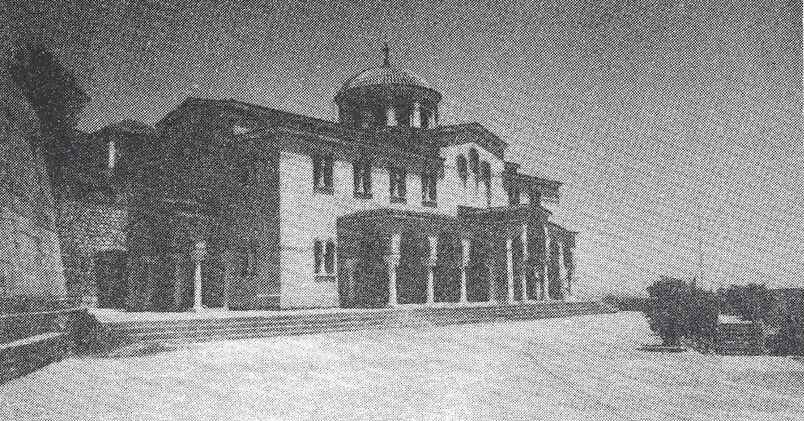
Contributions from Saskatchewan helped to build this imposing church in Ayios Nikolaos, (Kastri), consecrated in July 1982.
On the other hand, through migration Greece has benefitted in that its sons and daughters abroad have been able, by hard work in their overseas opportunities, to succeed and flourish economically, with some direct financial benefits flowing back through remittances to family and relatives in the old country.
Also, it is important to realize that while Greek culture is enriching life here, Canadian influences, in education and in other social matters, are carried into Greece through the efforts of her migrant sons and daughters, as they travel back and forth between Canada and the old country. (In some instances, Greeks with several years or even some decades of life-experience in Canada are found to be now permanently resettled in Greece.) The high ratio of university graduates in Greece is partly due to generous support to Greek schools at all levels, contributed by overseas diaspora Greeks.
HISTORICAL LINKAGES
Historically, the first Greeks in the province came here at the beginning of the century, mainly from the Peloponnesos (especially the province of Arcadia) and central Greece (province of Thessaly) and some from the islands and from near Constantinople.
Since the war, there has been continuing migration from Arcadia – the mountain towns of Kastri and Karytaina, and the plains town of Astros and from Kalamata, Aigion, and towns of the provinces of Corinth and the Argolid. More recently, there has been migration from the islands such as Euboia, Andros, Santorini, Crete, Zakynthos and Samos. Macedonia in northern Greece has also sent its share of immigrants, and Athens, the metropolis, is represented.
It will be remembered that Greece was a principal source of migrants after World War II, when about 108 thousand of them came to Canada between the years 1945 and 1971. These were very preponderantly youthful, approaching or just in the bloom of young adulthood and at their most vigorous. They migrated at the cost, for some of the smaller communities of origin in the old country of endangering their demographic survival in Greek villages. And so many fewer of that young generation were left as result of the intensely focused pulls by the chain-migration process. Nevertheless, the parents and collateral relatives left behind did serve to provide ties of kinship and clan which would persist between Canada and the old home-places.
A lively example of migration links with Canada is provided by a cluster of closely neighboring mountain villages called “Kastri” in the eastern Peloponnesos (about three-quarters of an hour by car or bus from the provincial Arcadian capital of Tripolis).
Historically, these seven related villages (Ayios Nikolaos, Mesorakhi, Horia, Karatoula, Nea Hora, Elato and Perthikovrissi) were (and are) socio-economically linked in a larger network of ties to other Arcadian places, particularly several in less mountainous districts or in the coastal plain such as Eliohorio and Astros. (Today, the wider linkages within Greece have extended strongly into Athens, too.)
Out of this setting has come the “Kastri connection” in Saskatchewan (which is both a strong sober reality and a basis for more or less good natured jokes by non-Kastri Greeks here). Nick and George Kangles together with Bill Girgulis of Saskatoon were most active in greatly accelerating the “chain migration” that brought Kastrites and others – but especially Kastrites – to Regina and Saskatoon. This chain migration process climaxed, with the largest actual flow of Greek immigrants to these places, during early years of the 1950’s. Some other Kastri clan names well known in business circles in Saskatchewan are Chrones, Pontikes, Kosmas, Bezbes, Spanos, Korolis, Karahalios, Giannaris, Geatros, Kokonas, Kounougeris, Rammos and Nikolaou.
THE SOCIO-CULTURAL DYNAMICS
The dynamics of clan or kinship relationships in Kastri are such that the structure of village life is based on a “clan barrio” arrangement. That is, families divide land through inheritance and children build their houses near each other so that the clan/soy is a distinct aspect of village topography.
One of the largest and most prominent barrios is that of the Pontikes family – referred to as the “Pontikianika”. This clan has sent out family members to Athens, Chicago, Regina and Saskatoon among other parts of the world, many of whom have become prominent in their communities.
Several other forces are at work in keeping the links and ties to the old country from lapsing. One is economic: Greece is still dependent on the income from the diaspora in the new world, Australia, and in European countries like Germany. In Kastri, one sees the economic effects through the building that goes on.
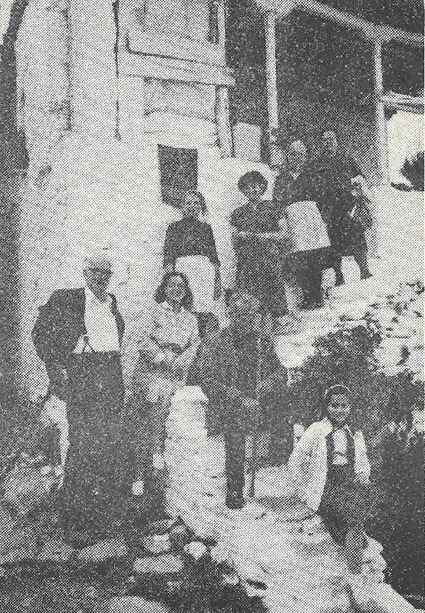
The village of Karatoula, Greece.Standing on left is Linvill Watson, seated beside him in Avra Watson
Funds have been sent over to build the new high school, the new main church of Ayios Nikolaos, and the broad new village square. Money which comes into the village is used for the construction of new houses there for Kastrites living in Chicago, Toronto or Regina and to repair and maintain old homes.
Ethnoculturally the ties to the old country are reinforced by the two-way visits. Saskatchewan Greeks return in the summer, while parents and grandparents come here, usually to spend the winter months and visit with their relatives. These visits also serve to reinforce the local village relationships.
In the main Kastri village of Ayios Nikolaos, as we saw this summer, there is a stream of visitors from Regina and Saskatoon as well as Chicago, Toronto, and elsewhere. They come to benefit from the mountain climate of the area and the proximity of Kastri’s seven villages to the beach resort of Astros which is no more than an hour’s drive away.
Another spin-off for multiculturalism from the flow of visitors in the summer is the exchange of knowledge about life in both places. Young people learn more deeply and more vividly about roots of their parents’ culture. They learn more about the flavour of the village life their parents had grown up with, about the mementos and stories for instance of the War of Independence in the 1820’s and its Arcadian hero Kolokotronis, as well as about the most recent and continuing changes in the lives of their Greek cousins both in the ancestral villages and in Greece’s modern cities. Conversely, the old-country relatives and their neighbours learn fresh details of the life over here as experienced by Greek Canadians.
All these two-way links that tie us together in a common understanding of each other’s culture can only enrich a nation like Canada and a province like Saskatchewan. And for a small, relatively poor nation such as Greece, which has always sent her children out to the four corners of the world, the implications are unusual: Greece has as many of her citizens in the diaspora as she has at home — nine million in each. The present Greek government of Andreas Papandreou (who himself lived in Toronto as an exile during the Junta period until 1974) has set up a Ministry of Hellenes (Greeks) abroad to act in developing two- relationships between these expatriates and the “old country” as well as to develop stronger intergovernmental relations between Greece and those Greek migrants’ adoptive homeland, Canada.
FOR REFERENCE SEE: THE CANADIAN ODYSSEY: THE GREEK EXPERIENCE IN CANADA, by Peter D. Chimbos, 1980. McClelland and Stewart Ltd.
Source: Avra Watson, “The Two-way Street in Multiculturalism – The Case of Saskatchewan Greek-Canadians: Local Linkages to the Kastri District in Arcadia, Greece”, Golden Anniversary Booklet – Annual Convention – Royal Canadian District 24, Order of AHEPA and Daughters of Penelope, Saskatoon, May 1983.
St. Nicholaos Society of Saskatoon (1950s)
Besides supporting community events and philanthropic activities to benefit the citizens of Saskatoon, members of the Greek Community generously contributed to fund-raising projects to support the people of their homeland. One example is the creation of the St. Nicholaos Society in Saskatoon and Regina. Members of the Society raised money to assist with the construction of St. Nicholaos (Ayios Nicholaos) Greek Orthodox Church in Kastri (Arcadia) Greece – where many Greeks had relatives.
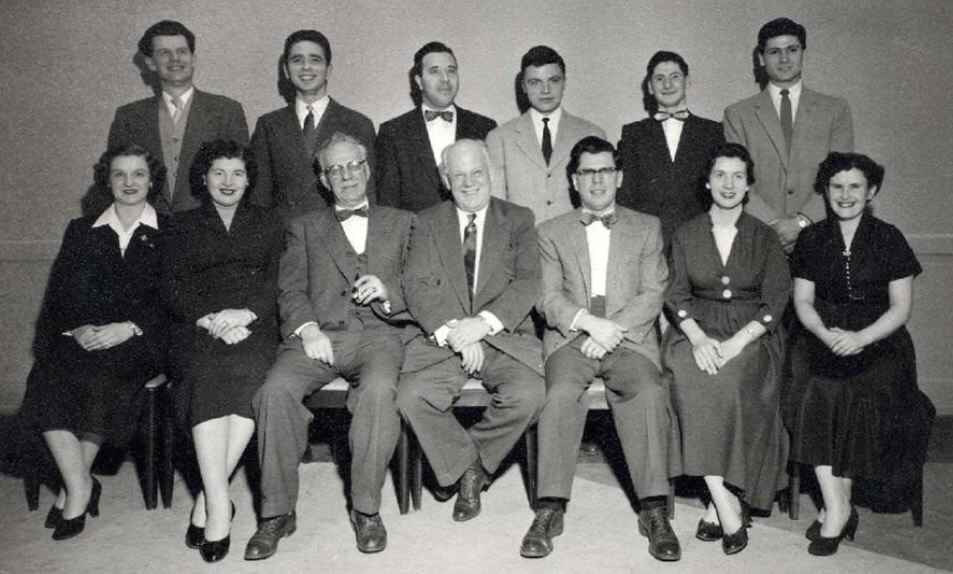
Members of the St. Nicholaos Society of Saskatoon, 1956
Back row (left to right): Kosta Georgoulis, Gus Foufas, John Pontikes, John Simnos, Spero Bezbes, James Kosmas
Front row (left to right): Effie Girgulis, Sophia Pontikes, James Girgulis, William Girgulis, Sam Girgulis, Kiki Pontikes, Vaso Papthostavros
Greek War Relief (1940s)
Editorial Note: Greek War Relief was an initiative of North American Greeks to support the population in Fascist/Nazi occupied Greece during World War 2.
At the outset of World War 2, Greece maintained a neutral position. However, this position changed on October 28, 1940.
At 3:00 a.m. on October 28, the Fascist ambassador to Greece, Emanuele Grazzi, presented Greek Premier Ioannis Metaxas with an ultimatum. He revealed that 200,000 Italian troops waiting at the Albanian-Greek border would begin marching into Greece at 6:00 a.m. and demanded that Greece must provide “unmolested military passage” to them. The Fascists and Nazis saw Greece as an easily-surmountable obstacle to position their troops to seize the Suez Canal from British control.
Metaxa’s response was “Oxi” (“No”)! The ultimatum was considered to be declaration of war by Italy on Greece. At dawn, the Fascist troops moved across the Greek border.
Greece’s infantry of Evzones consisted mostly of shepherds and peasants from the mountain villages. By the middle of November and with only guns, bayonets, hand grenades, and rocks, the Evzones pushed the Fascist forces back into Albania and captured 28,000 prisoners. The Fascist leaders called on the Nazis for reinforcements. For 14 weeks, the Greeks managed to occupy the attention of the Axis, but more important, they gave the Allies time to prepare their next offensive against the Nazis.
In Canada, reports of Greece’s fight against the Axis were inspiring. Even though they eventually succumbed to the Axis military might, Greece was clearly seen as on the side of the British Empire and there were no doubts among the Canadian public that the Greek population here was loyal and trustworthy.

Saskatoon Star-Phoenix, April 2, 1941
When the Greece could no longer hold back the combined power of the Axis forces in 1940, the Nazi occupiers were determined to punish the Greeks for their defiance. They also needed to put down continued sabotage and destruction by Greek guerilla fighters of Nazi communications, warehouses, troop trains, ships, and food supplies located in Greece. Greeks showed contempt for their occupiers and admiration for Great Britain.
Nazi revenge took the form of brutal treatment of Greek civilians, including severe punishments, imprisonment, and executions. They also engaged in a program of mass starvation and of withholding medical treatment. Homes were looted and people had inadequate clothing to survive the winter. By September 1941, reports indicated that more than 1,000 people (mostly children) were dying each day in Athens.
North American Greeks were learning about the plight of the people of Greece – many of them being relatives. However, they were unable to help because relief supplies were blocked from entering Greece.
As early as November 1940 and on the urging of the Canadian government, a national organization, The Greek War Relief Fund, was established under the authority of The War Charities Act. A nation-wide fund-raising campaign was launched with a goal of raising $500,000 for medical, clothing, and general relief supplies for shipment to Greece, when possible, through the Canadian Red Cross.

The organizers of the campaign were overwhelmed by support from all parts of Canada. People throughout Canada wanted to participate in gratitude towards the Greek people who had fought the Axis forces when the odds were so much against them.
The Greek War Relief Fund was headquartered in Montreal. There were also provincial committees and local committees. In Saskatchewan, there were five local committees, each with a Greek-Canadian chairperson: Moose Jaw (chaired by Gus Pappas), Regina (George Kangles), Prince Albert (Tom Peters), Saskatoon (James Chrones), and Swift Current (Gus Gillas).

Saskatoon Star-Phoenix, December 7, 1940, p. 3.
As donations started to flow into the Fund, attention was directed to how the relief supplies purchased by the money would reach the people of Greece. Initial shipments were indirectly shipped through Egypt, Turkey, and Sweden.
In 1942, with the diplomatic assistance of the King of Sweden and a fleet of Swedish ships, as well as a commitment from Canada to donate 15,000-ton shipments of wheat per month, an agreement was reached to allow shipments of relief supplies into Greece. An important condition placed by the Nazis was that the shipments would be unmarked and therefore, that the Greek people would not be aware of the origins of the relief.
Between 1940 and 1947, Greek War Relief raised $4.3 million in cash and in-kind donations.

Saskatoon Star-Phoenix, June 19, 1943, p. 10.
Researched by Ken Pontikes, October 15, 2025